
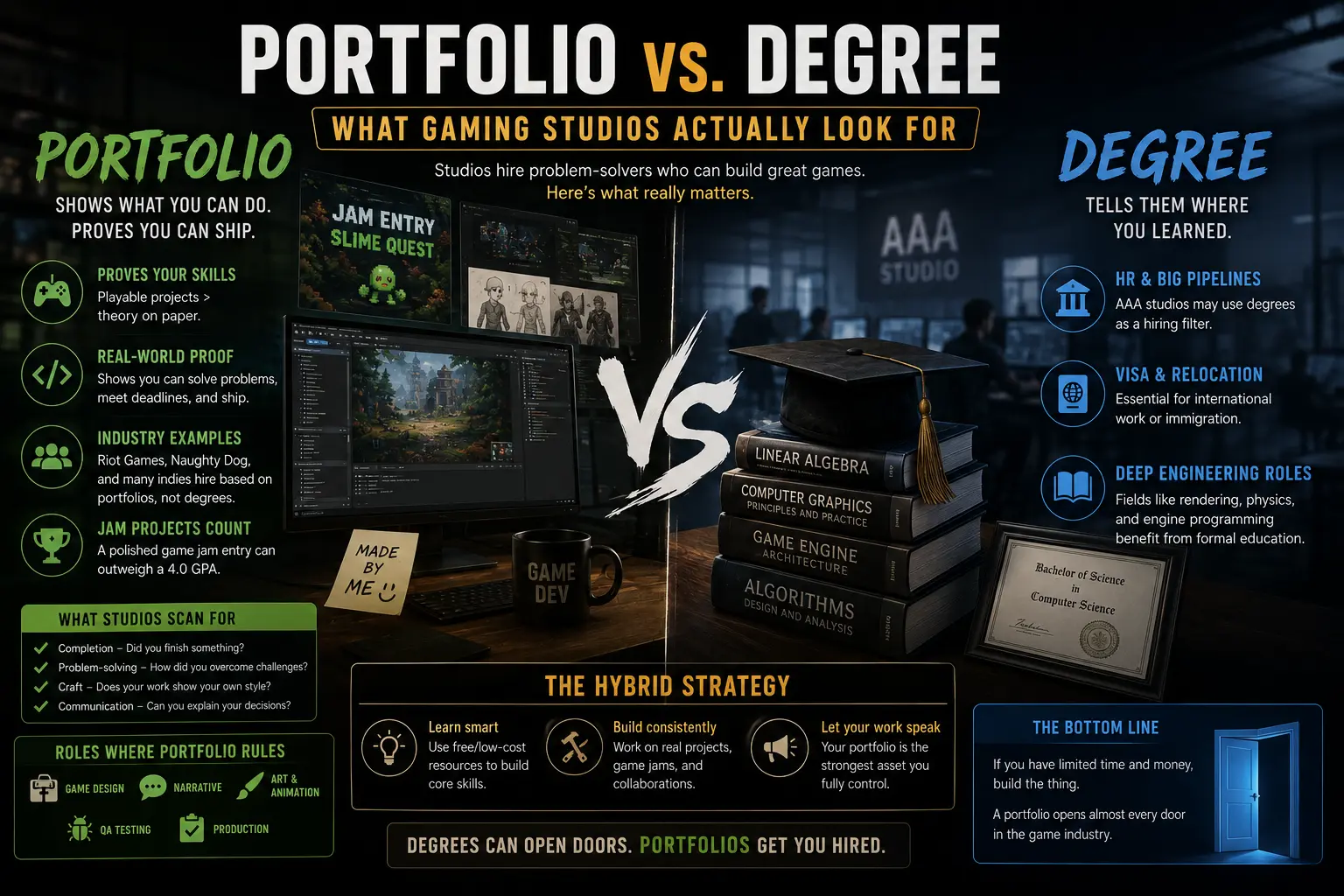

Every aspiring game developer has this confusion: whether to go for a game dev degree or work on building a strong portfolio. And you definitely should have this confusion, because getting a degree means paying a lot of money, and spending four years daily going to a place where they will teach you something.
In comparison, building a portfolio means learning everything from scratch. But here you won’t be paying a lot of money, nor be spending time at one place for a fixed time. You can surprisingly use that money to get into game jams and workshops, where you will learn actually valuable skills, instead of just rote-learning code or an engine.
Why Portfolios Win the Argument
Game development is a craft discipline. Studios aren’t hiring you to just write code; they’re hiring you to ship playable, polished work under deadline pressure. A portfolio tells them you are capable of solving real technical problems and making something a player would actually want to play, instead of a degree, which just tells them you have a degree but lack hands-on experience.
This is why studios like Riot Games, Naughty Dog, and countless indie houses have hired self-taught developers whose GitHub repos or itch.io pages spoke louder than any piece of paper. A single well-executed game jam project, with clean code, a working build, and a postmortem showing what you learned, often outweighs a 3.5 GPA in a related field.
Where Degrees Still Matter
That said, degrees aren’t dead weight. Three places they carry real value:
Large studios with structured pipelines. AAA companies like EA or Ubisoft sometimes use degree requirements as an HR filing filter for high-volume roles, especially engineering positions requiring deep systems knowledge (engine architecture, graphics programming, AI systems).
Visa and relocation cases. If you’re applying internationally, immigration pathways in countries like Canada or Germany often require formal credentials regardless of talent.
Foundational engineering roles. Rendering engineers, physics programmers, and tools engineers benefit from formal training in linear algebra, computer graphics, and systems design, knowledge that’s harder (not impossible) to self-teach to a hireable standard.
The Roles Where Portfolio Dominates Completely
For design, narrative, art, animation, QA, and production roles, portfolios are essentially the entire application. A level designer’s playable blockout matters infinitely more than their major. A narrative designer’s dialogue tree or branching script sample tells a hiring manager more in five minutes than a resume line ever could.
What Studios Are Actually Scanning For
When a hiring manager opens your portfolio, they’re not looking for perfection; they’re looking for signal:
- Completion — did you actually make a finished game, or is everything a prototype?
- Problem-solving skill — how did you handle scope, bugs, or tight timelines?
- Craft specificity — does your work show a point of view, or does it look like you copied a tutorial as it is?
- Communication — can you explain your decisions clearly (this matters hugely for narrative and design roles)?
The Practical Takeaway
If you have to choose where to invest your limited time and money, build the thing. Building a game from scratch can teach you a lot of things that a degree would teach you in a four-year course.
A degree can open specific doors, especially for engineering-heavy or international roles, but a portfolio opens almost every door in the industry, and it’s the one asset you fully control.
The real hybrid strategy: use free or low-cost resources to build core competency, and let your finished work do the talking in the application.
Keep following the Game Insider Blog for more such articles.