
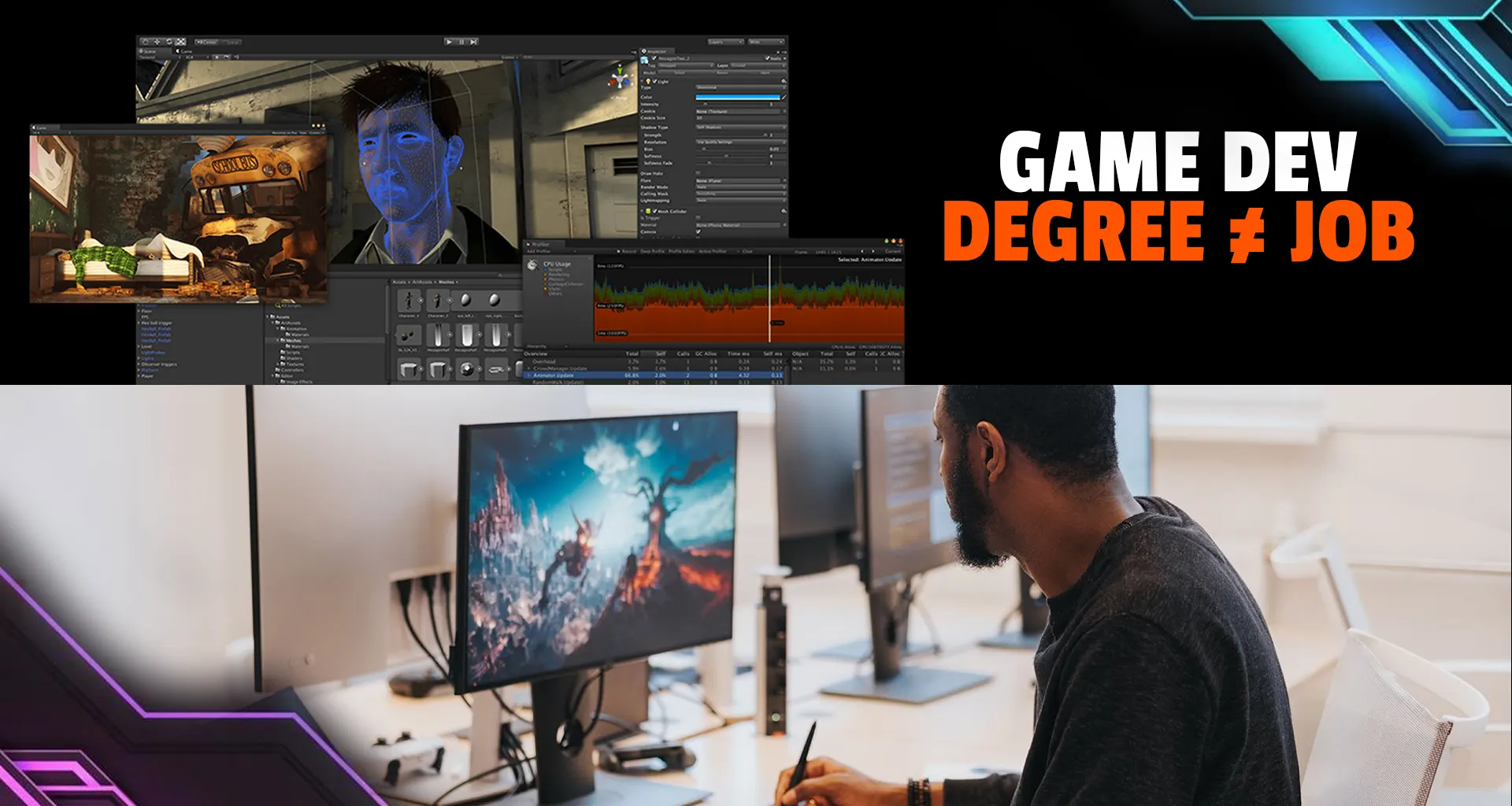

The global gaming industry continues to expand at an extraordinary pace. New studios emerge, live-service titles demand ongoing updates, and game engines evolve rapidly. Yet despite this growth, a troubling contradiction persists: thousands of graduates complete game development programs each year and still struggle to secure employment in professional studios.
The issue is not a lack of passion. It is not a lack of intelligence.
It is a structural disconnect between education and production reality.
Most game development courses do not prepare students for how games are actually built.
They produce familiarity with tools — not readiness for studios.
To understand why this gap exists, we must examine how traditional curricula are structured and what studios truly value.
The Illusion of Tool Mastery
A large number of courses center around learning a specific engine — Unity, Unreal Engine, or another development tool. Students are guided through interface walkthroughs, asset imports, scene setup, and basic mechanics.
This creates confidence.
But it rarely creates competence.
In professional environments, developers are not hired because they know where buttons are located in an engine. They are hired because they can:
- Solve unexpected technical problems
- Debug complex systems
- Work within constraints
- Communicate trade-offs
- Deliver under deadlines
Production environments are messy. Features break. Design directions shift. Technical debt accumulates. Builds fail. Teams depend on one another.
Understanding menus is not the same as understanding production.
The “Generalist” Problem
Many programs promise to teach students how to “make a complete game from scratch.” On the surface, this sounds comprehensive. In practice, it spreads students thin across too many disciplines.
Game development is not one job. It is a network of highly specialized roles, including:
- Gameplay Programmers
- Technical Artists
- Level Designers
- UI/UX Designers
- QA Engineers
- Producers
- Live Operations Analysts
Professional studios rely on depth. They hire individuals who can own a specific responsibility within a pipeline.
When students attempt to learn modeling, animation, programming, design, and audio simultaneously, they often develop surface-level familiarity in each area, but mastery in none.
Without specialization, portfolios lack clarity. Recruiters cannot identify what role the candidate is suited for. That uncertainty often results in rejection.
Portfolios That Fail to Differentiate
In hiring, portfolios matter more than certificates.
Yet many student portfolios contain identical projects built from widely available tutorials. When recruiters review dozens of similar 3D shooters or platformers constructed from the same instructional series, differentiation disappears.
What studios look for is not perfection — it is thinking.
Strong portfolios demonstrate:
- Original mechanics or thoughtful variation
- Clear documentation explaining decisions
- Evidence of iteration and refinement
- Problem-solving under constraint
A project that evolved through testing and feedback signals maturity. A copied tutorial signals repetition.
Studios are not evaluating whether you followed instructions correctly. They are evaluating whether you can contribute to real production.
The Missing Piece: Pipeline Exposure
One of the most overlooked gaps in traditional education is exposure to professional workflows.
In real studios, features move through structured pipelines. Designers collaborate with programmers. Artists integrate assets into builds. QA testers log bugs through tracking systems. Producers coordinate milestones.
Students rarely experience:
- Version control systems like Git or Perforce
- Task tracking tools
- Structured bug reporting
- Cross-functional collaboration
- Review cycles and sprint planning
Without understanding how teams operate, candidates enter interviews unprepared for questions about collaboration, process, and communication.
Knowing how to build a game alone is not the same as knowing how to build one within a team.
The Overlooked Importance of Soft Skills
Technical skill alone does not secure employment.
Game development is inherently collaborative. Teams rely on communication, feedback cycles, and structured problem-solving.
Studios seek individuals who can:
- Explain their reasoning clearly
- Accept critique professionally
- Adapt to changing requirements
- Work within hierarchy
- Respect deadlines
A technically strong candidate who struggles with communication can disrupt production. Conversely, a solid contributor who collaborates effectively becomes valuable quickly.
Professional behavior is not secondary to technical ability, it is part of it.
What Actually Creates Hireable Talent
If traditional courses fall short, what works?
Project-Based Learning Under Real Constraints
Students must build within deadlines, defined scopes, and collaborative structures. Constraint builds discipline.
Game Jams and Rapid Iteration
Game jams simulate real-world pressure. They require fast decision-making, role clarity, and delivery within time limits.
Feedback from Working Professionals
Constructive critique from industry practitioners reveals blind spots that peer feedback cannot.
Early Specialization
Choosing a role and going deep creates identity. Depth makes portfolios clearer and interviews stronger.
Evidence of Growth
Recruiters value progression. A portfolio that shows how an idea evolved often carries more weight than one polished but static project.
A Necessary Shift in Perspective
The gaming industry does not need more students who can replicate tutorials.
It needs:
- Specialists who understand pipelines
- Problem solvers who think critically
- Collaborators who communicate clearly
- Creators who iterate deliberately
Education must move beyond tool familiarity and toward production readiness.
Certificates may open conversations.
Skills, clarity, and professional thinking secure positions.
The future of game development education lies not in promising students they can “build anything,” but in preparing them to build something well, within a real team, under real constraints, for real players.
That is what makes talent hireable. Checkout Game Insider’s Game Dev Program and keep following the GI Blog.