
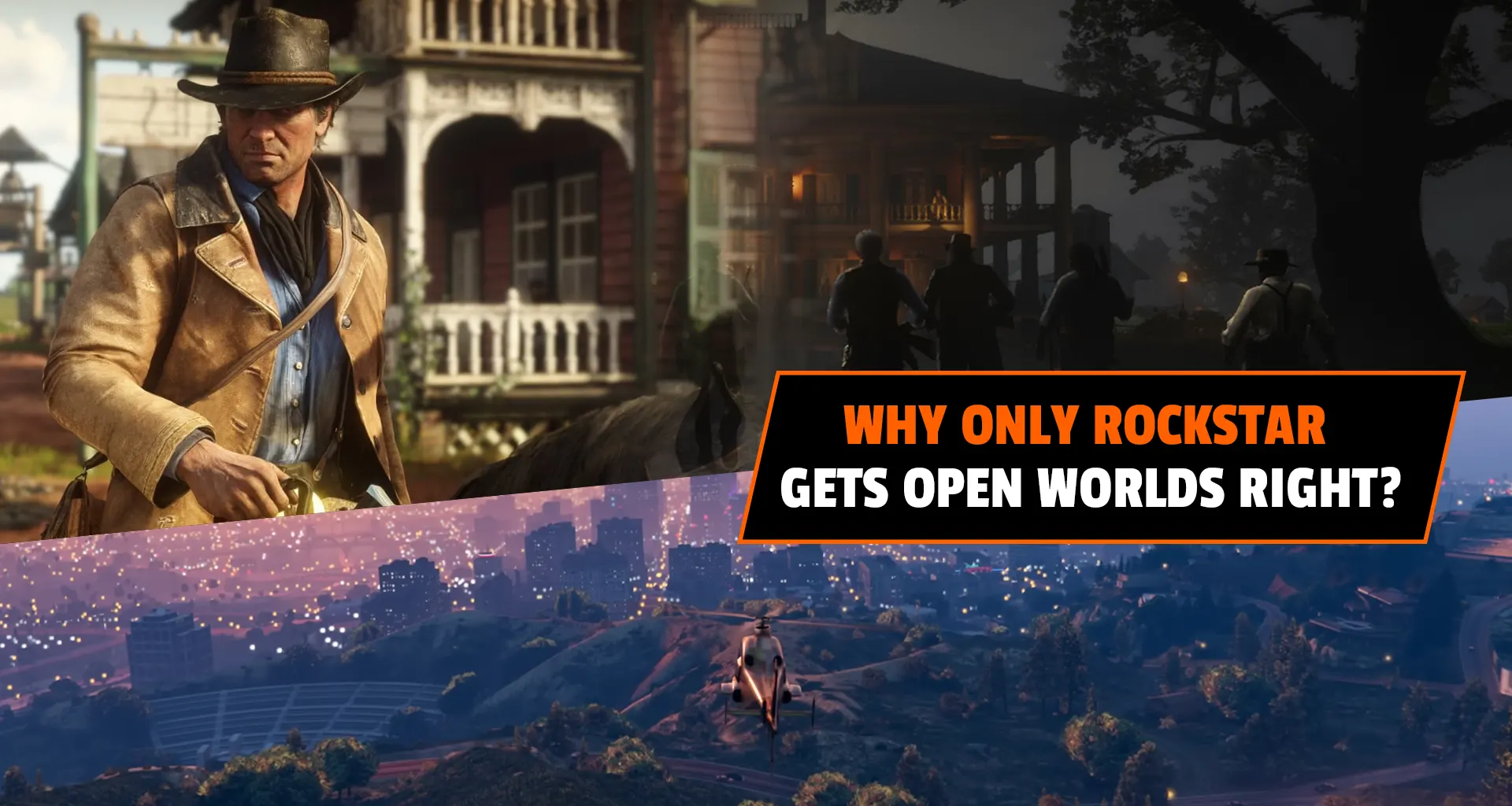

Open-world games have become one of the most popular genres in modern gaming. Vast cities, dynamic NPCs, and player freedom have turned these worlds into digital playgrounds. While studios like Bethesda, CD Projekt Red, and Nintendo have achieved monumental success in this space, very few developers have reached the same level of high-fidelity simulation and cinematic integration as Rockstar Games.
From Grand Theft Auto: San Andreas to Grand Theft Auto V and Red Dead Redemption 2, Rockstar has repeatedly set the gold standard for what a realistic, living open world should feel like.
When looking at Rockstar vs other game developers, many studios have tried to emulate their formula, yet most fall short. The reason lies in a specific combination of critical factors that Rockstar has mastered over the years.
The World Feels Alive, Not Just Large

Most open-world games focus heavily on size. Developers advertise massive maps filled with icons, collectibles, and side quests. However, size alone does not create immersion.
Rockstar’s approach is different. Their worlds are designed to feel alive rather than merely expansive. NPCs follow daily routines, random events occur naturally, and the environment reacts to the player’s actions.
In Red Dead Redemption 2, townsfolk remember your past behavior, animals interact with each other in a functioning food chain, and the world evolves as the story progresses. This level of environmental simulation creates the illusion of a breathing ecosystem rather than a static game map designed only to host missions.
Years of Development Time

If you have ever wondered why GTA games take so long to make, the answer lies in Rockstar’s patience. Modern AAA studios often work under strict release schedules, pushing games out every few years to maintain revenue flow.
Rockstar operates differently. Their games take an extraordinary amount of time to develop. Grand Theft Auto V took around five years to build, while Red Dead Redemption 2 reportedly required nearly eight years of development across multiple global studios.
The upcoming Grand Theft Auto VI will release well over a decade after GTA V, with primary production having kicked off around 2020. This extended timeline allows Rockstar to obsessively polish their games and introduce advanced, groundbreaking features, resulting in worlds that feel far more complete than those of their competitors.
Narrative Depth Within an Open World
Open-world storytelling is notoriously difficult. When players have the freedom to roam anywhere, maintaining pacing and a compelling narrative becomes a monumental challenge. Many studios solve this by weakening the main story and focusing purely on gameplay systems.
Rockstar does the opposite. Their games feature tightly written narratives that unfold alongside player exploration. Characters evolve naturally, dialogue feels incredibly cinematic, and missions often blur the line between gameplay and premium television.
The character arcs in Red Dead Redemption 2, for example, rival those found in prestige film and TV, making the emotional experience as powerful as the gameplay itself.
The Trade-Off: Total Freedom vs. Directed Experiences
However, Rockstar’s approach is not without its critics, and their unique formula comes with a notable trade-off. While the open worlds themselves offer unparalleled freedom, the actual story missions are famously rigid and linear.
In games like The Legend of Zelda: Breath of the Wild, players are given a goal and the freedom to solve it using any system in the game. In contrast, Rockstar tightly controls the narrative experience. Stepping slightly off the designated path or attempting to approach a mission creatively often results in an immediate “Mission Failed” screen.
This creates a slight disconnect, incredible freedom in the open world, but strict, cinematic direction during the story. Yet, for millions of players, this highly curated, blockbuster-style storytelling is exactly what makes a Rockstar game so captivating.
Technical Mastery and Proprietary Technology
A massive advantage Rockstar holds is its proprietary game engine, RAGE (Rockstar Advanced Game Engine). This technology has been refined across multiple projects, allowing the studio to consistently push boundaries in physics, animation, and world interaction.
While many studios rely on general-purpose software, the proprietary RAGE engine’s open-world capabilities are tailored specifically for Rockstar’s unique brand of game design. This allows them to simulate complex, heavy systems such as realistic vehicle deformation, dense traffic patterns, environmental physics, and weight-based character animations without sacrificing immersion. The result is a seamless, tactile experience where the world rarely feels artificial.
Cultural Influence and Satirical Worldbuilding
Rockstar’s games also succeed because they capture culture. The cities in the Grand Theft Auto franchise are not simply maps; they are exaggerated, cynical reflections of real society.
Through highly produced satirical radio stations, in-game advertisements, ambient NPC conversations, and mission themes, Rockstar creates worlds that comment on politics, media, and modern life. This cultural layer makes exploration entertaining even when players are just driving around. Many open-world games build large maps but completely fail to create this sense of cultural authenticity.
Financial Risk Few Studios Can Take
Producing a Rockstar-level open world is exceptionally expensive. Budgets for their modern titles often exceed hundreds of millions of dollars. Only a handful of publishers in the world can afford to take such a risk.
Even if other studios possessed the talent and desire to replicate Rockstar’s approach, the financial gamble would be enormous. A failed project of that scale could bankrupt an entire company. As a result, most studios choose safer, more sustainable development strategies, smaller worlds, reused systems, or faster release cycles.
The Consistency Factor
Many developers have created excellent open-world games. What truly sets Rockstar apart, however, is consistency. Nearly every major release from the studio redefines expectations for the entire gaming industry.
Ultimately, the brilliance of Rockstar’s open-world design is not the result of a single factor, but a combination of uncompromising philosophy, proprietary technology, and immense patience. Their commitment to detailed world simulation, strong storytelling, and extended development cycles has allowed them to build worlds that feel genuinely alive.
Until more developers are willing and financially able to invest the same time, resources, and creative ambition, Rockstar will likely remain the ultimate benchmark for the open-world genre.
Keep following the Game Insider Blog for more such informative articles.