

While critics dismissed it as a ‘low-end’ clone, Free Fire’s $1 Billion+ revenue proves that accessibility is the ultimate game mechanic. It didn’t win by having the best graphics; it won by solving the ‘friction’ of mobile hardware. Here is how Garena deconstructed the Battle Royale to fit into the pocket of the global masses.
Mobile battle royale games have become a massive part of modern gaming culture, particularly in regions where smartphones are the primary gaming device. Among these titles, Free Fire, developed by Garena, stands out as one of the most successful and widely played games globally.
Deconstructing Free Fire reveals the design decisions, systems, and player-focused mechanics that helped the game become one of the defining titles of the mobile gaming era.
The Core Gameplay Loop
At its foundation, Free Fire follows the traditional battle royale structure. Fifty players drop onto an island where they must search for weapons, equipment, and resources while competing to survive.
As the match progresses, the playable area gradually shrinks, forcing players into increasingly intense encounters until only one player or squad remains.
The core gameplay loop can be summarized as:
- Drop – Players choose where to land on the map.
- Loot – Collect weapons, armor, and utilities.
- Engage – Fight enemies or strategically avoid them.
- Survive – Stay within the safe zone while eliminating opponents.
- Win – Become the last surviving player or team.
However, Free Fire introduces additional systems that extend this loop and make matches more dynamic.
For example, the game includes revival mechanics that allow players to re-enter the match after elimination. In solo mode, players have a limited extra lifeline that allows them to revive instantly once.
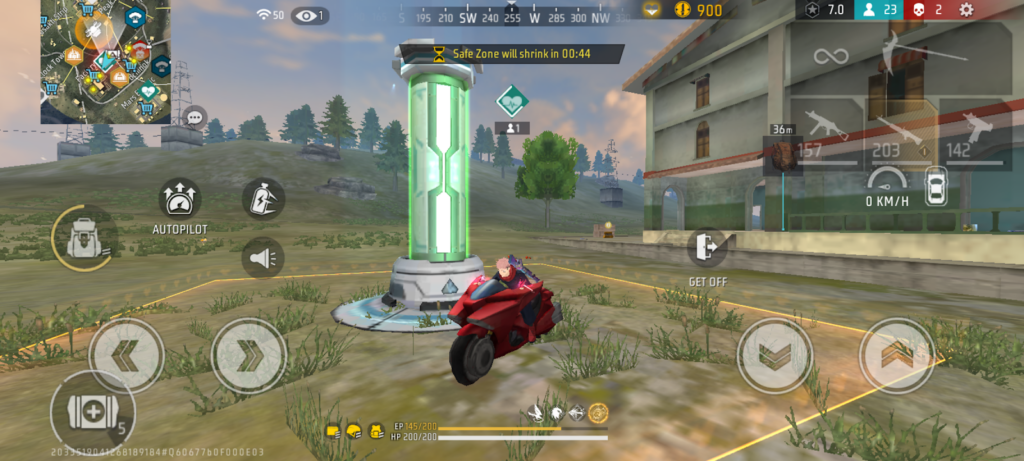
In squad modes, the system becomes even deeper. Players can be revived through revival points placed across the map or by using revival cards purchased from vending machines.
Revival points are often placed in exposed areas, creating high-risk situations where teams must defend their position while bringing teammates back into the match. Meanwhile, vending machines offer players the ability to purchase weapons, ammo, and revival cards using in-game currency called FF Coins.
These additional systems create a secondary meta-loop, where survival is not just about staying alive but also about managing resources and revival opportunities.
Another key design decision is match length. Free Fire matches typically last 10–15 minutes, significantly shorter than many battle royale games. This aligns perfectly with mobile gaming habits, allowing players to enjoy quick sessions anytime and anywhere.
Map and Spatial Design
Free Fire’s maps are designed to support multiple playstyles, encouraging both aggressive combat and strategic positioning.
Different areas of the map include:
- Urban zones
- Open fields
- Forested regions
- Industrial structures
These environments provide varied tactical opportunities and keep gameplay unpredictable.
High-density loot zones are highlighted in blue, attracting players seeking early combat. Meanwhile, quieter areas allow players to gather resources and prepare before engaging in fights.
The shrinking safe zone is another crucial spatial mechanic. By gradually forcing players closer together, the game maintains constant tension and prevents matches from becoming slow or stagnant.
Verticality also plays an important role in the game’s design. Buildings, hills, and elevated structures provide cover and strategic advantage, encouraging players to think carefully about positioning, movement, and terrain control, rather than relying purely on gunplay.
Weapon and Combat Systems
Free Fire offers a diverse range of weapons, including:
- Assault rifles
- Shotguns
- Sniper rifles
- Submachine guns
- Pistols
- Melee weapons
Each weapon category serves a distinct role in combat. Shotguns and SMGs dominate close-range encounters, while sniper rifles and assault rifles are more effective at long distances.
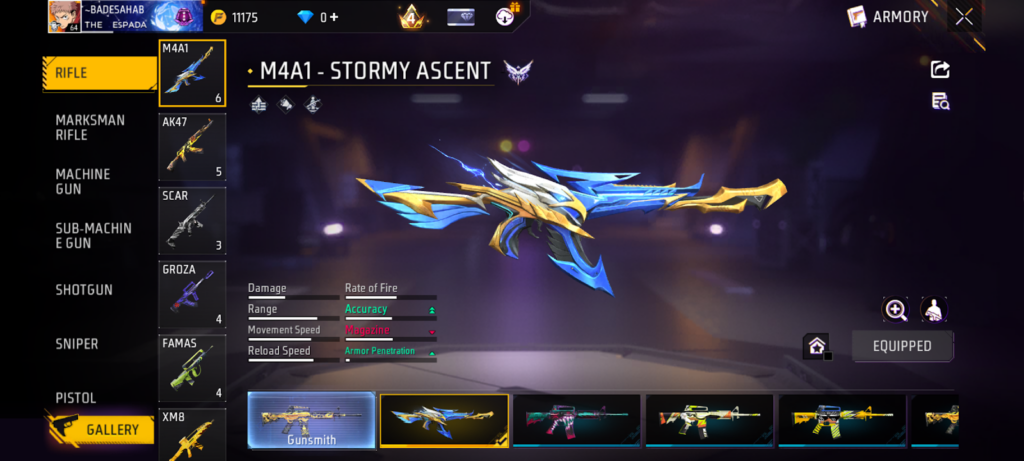
One design element that differentiates Free Fire from other battle royale titles, such as PUBG Mobile / BGMI, is the weapon skin system.
Certain gun skins provide gameplay buffs, such as:
- Improved recoil control
- Faster reload speed
- Increased damage output
While these advantages can give experienced players a slight edge, skill still plays a significant role in combat outcomes.
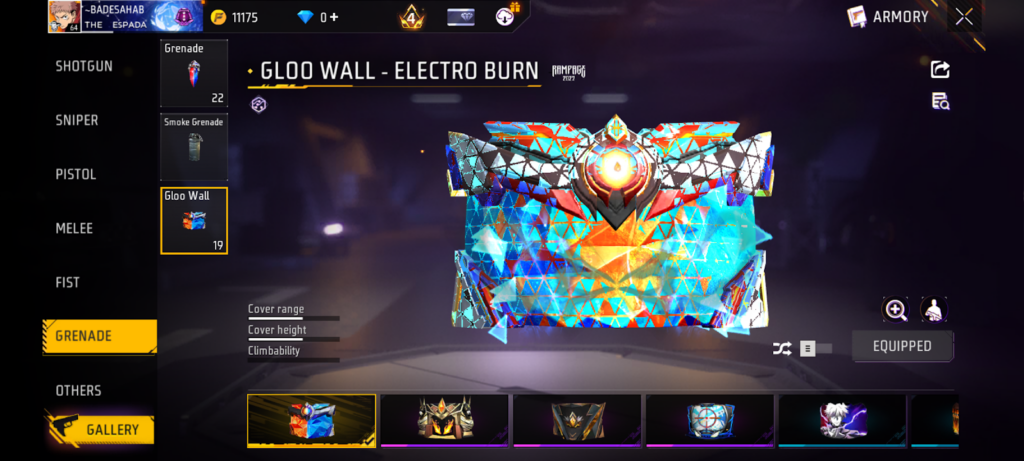
Another unique gameplay mechanic is the Gloo Wall. This deployable barrier allows players to instantly create cover during combat, enabling aggressive fights in open areas.
The Gloo Wall mechanic fundamentally changes combat dynamics by encouraging fast reactions, tactical placement, and creative defensive strategies.
Free Fire’s combat system is also designed to be accessible and forgiving. Aim assistance and simplified control schemes allow players to focus on decision-making and positioning rather than struggling with complex shooting mechanics.
Character Ability System
One of Free Fire’s most distinctive features is its character ability system.
Each playable character has unique abilities that can influence gameplay in various ways, including movement, healing, damage output, or tactical advantages.
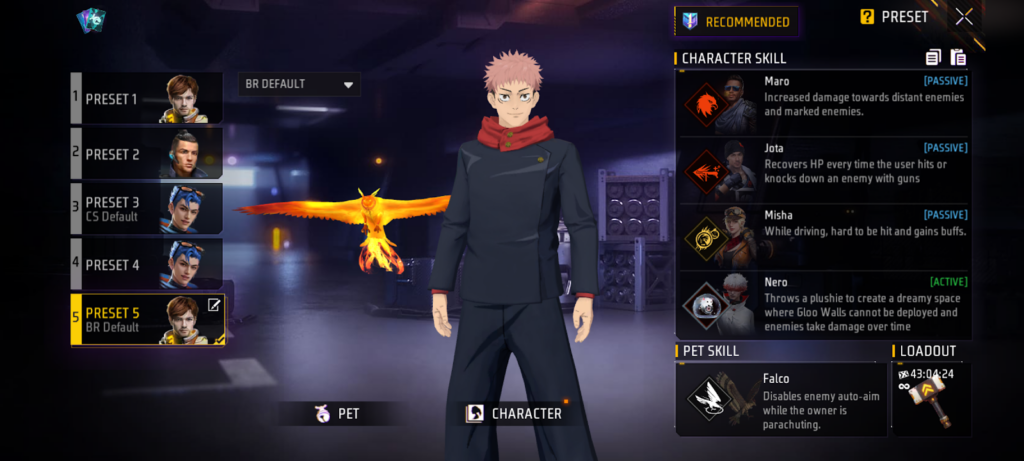
For example, the character Maro provides increased damage towards distant enemies, making it perfect for Marksman and Assault rifle
Other characters may:
- Increase movement speed
- Improve healing efficiency
- Boost firing rate
- Enhance throwable usage
These abilities allow players to build loadouts that match their preferred playstyle.
Free Fire also introduces a pet system, where companion animals provide gameplay bonuses. Unlike many games where pets are purely cosmetic, Free Fire’s pets offer functional advantages.
One example is Falcon, whose ability disrupts opponents’ auto-aim while the player is airborne. This ability becomes particularly valuable during high-pressure situations, such as being revived in late-game combat zones.
Importantly, the game maintains balance through a checks-and-balances design philosophy. No character or ability provides complete dominance; each advantage has a potential counter, ensuring competitive fairness.
Progression and Monetization
Free Fire follows a free-to-play model, generating revenue through cosmetic items and optional in-game purchases.
Players can unlock characters, skins, outfits, and weapon designs through gameplay progression or premium currency.
The progression system includes:
- Character leveling
- Seasonal events
- Ranked competitive modes
- Battle passes
- Limited-time rewards
These systems create long-term engagement by providing players with clear progression goals and regular content updates.
Free Fire also keeps its ecosystem fresh through frequent collaborations with major entertainment franchises. The game has partnered with popular properties such as:
- Naruto
- Jujutsu Kaisen
- Squid Game
- Money Heist
These collaborations introduce themed cosmetics and limited-time content, keeping the player base engaged.
Social and Community Design
Another key factor behind Free Fire’s success is its strong social design.
Players can form squads, communicate through voice chat, and participate in cooperative gameplay modes. This encourages team-based strategy and strengthens player retention.
Free Fire has also developed a large esports ecosystem, particularly in regions such as Asia and Latin America. Competitive tournaments, professional teams, and streaming communities have turned the game into a central part of the mobile esports landscape.
Technical Accessibility
Perhaps the most important design decision behind Free Fire’s success is its commitment to technical accessibility. Unlike many high-end mobile games that require powerful devices, Free Fire is optimized to run efficiently on low-spec smartphones.
By prioritizing performance optimization and efficient graphics design, Garena ensured the game could reach millions of players across emerging markets. This accessibility helped Free Fire expand rapidly in regions such as India, Southeast Asia, and Latin America, where high-end gaming hardware is less common.
Free Fire’s success is far from accidental. Its design carefully balances accessibility, fast-paced gameplay, and strategic depth.
Short match durations, character abilities, optimized performance, and strong social systems all contribute to the game’s lasting popularity.
By combining battle royale fundamentals with hero-style abilities and mobile-optimized design, Free Fire has secured its place as one of the defining mobile games of its generation.
Keep following Game Insider Blog for more such articles.