
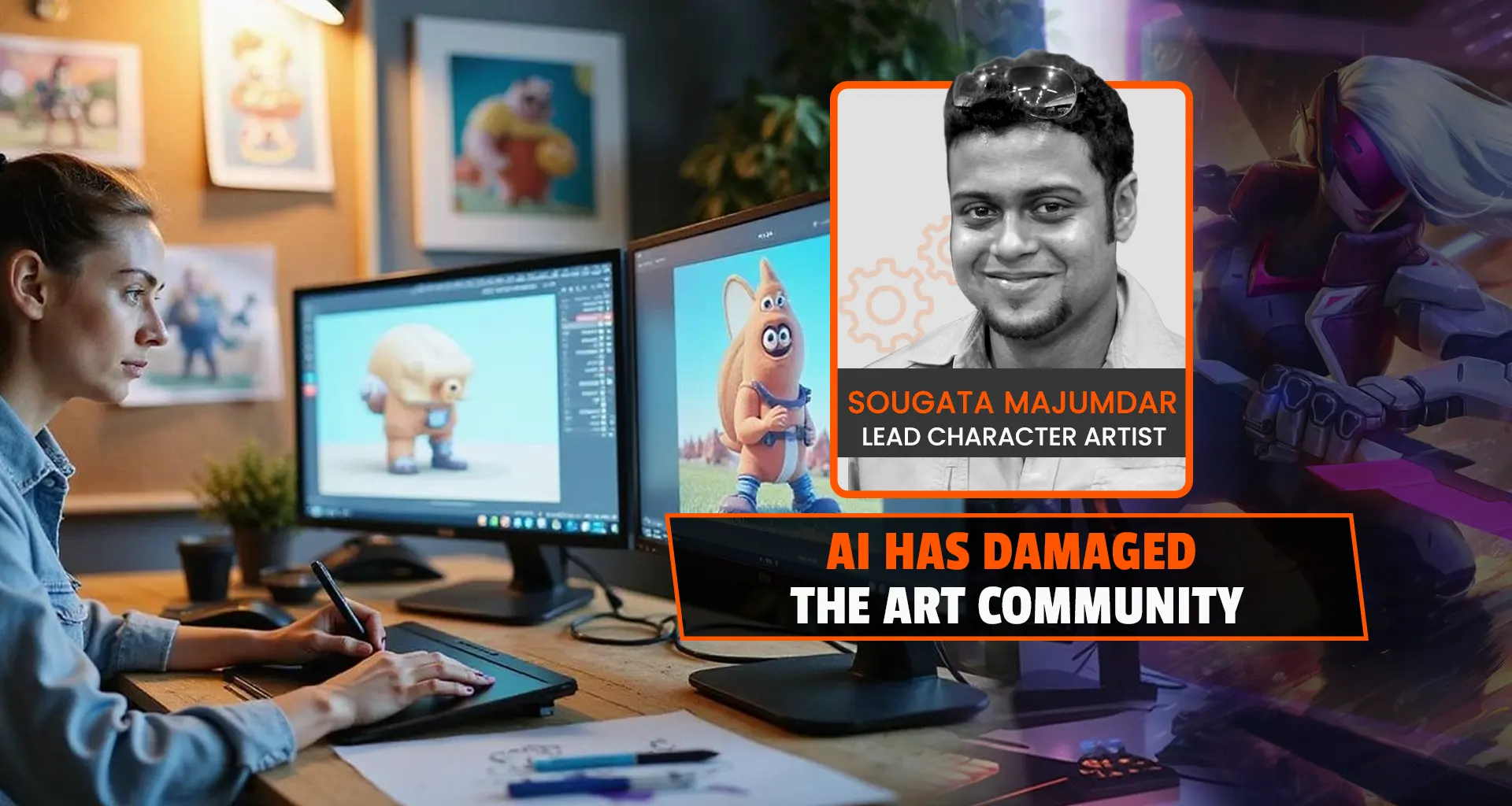

The leap from passionate hobbyist to professional artist at global studios like Ubisoft or Garena requires more than technical skill.
In 2026, the landscape has shifted. Generative AI tools are accelerating production. Game engines are becoming more powerful. Hiring expectations are sharper. Competition is global.
So what does it really take to land — and survive in — a “dream role” today?
In this candid session, Game Insider Mentor Sougata Majumder shares what most beginners get wrong, how to think about specialization, how to design original sci-fi in a “copy of a copy” world, and how artists can survive in the AI era by finding the gaps others miss.
The #1 Portfolio Killer
“The biggest portfolio killer is lack of information.”
According to Sougata, most beginners misunderstand what studios are evaluating.
A portfolio is not just a gallery.
It is proof of thinking.
When recruiters open an artwork, they should immediately understand:
- What was the goal of this piece?
- What was your role?
- What was the pipeline used?
- Which tools were involved?
- What challenges did you solve?
- How did you optimize for production?
Too many portfolios show beautiful renders — but no breakdown.
In production, clarity matters more than aesthetics alone.
And remember:
Quality always beats quantity.
Three production-ready pieces with breakdowns will outperform fifteen unfinished renders every time.
Specialist vs Generalist: What Should Students Do?
For someone starting today, the temptation is to learn everything — modeling, texturing, rigging, lighting, Unreal integration.
Sougata’s advice is clear:
“Master character art first.”
Why?
Because character art forces you to understand:
- Anatomy
- Sculpting fundamentals
- Silhouette and shape language
- Detail hierarchy
- Balance and proportion
Character art builds foundational artistic intelligence.
Becoming a generalist is valuable — but that transition happens naturally over time. Early on, focus deeply. The subject is vast. Shallow learning leads to shallow portfolios.
Depth creates authority.
Designing Sci-Fi in a “Copy of a Copy” World
David Fincher once echoed the idea in Fight Club:
“Everything is a copy of a copy of a copy.”
In-game art, this feels painfully true. Sci-fi especially risks visual repetition.
So how do you avoid designing something that looks like everything else?
Sougata’s approach is methodical:
- Build a Mood Board First
Use platforms like Pinterest and ArtStation — but don’t limit references to sci-fi. - Break Genre Boundaries
Architecture. Military gear. Marine biology. Industrial design. Nature.
Unexpected combinations create freshness. - Assemble, Don’t Imitate
Originality rarely means inventing something from nothing.
It means recombining ideas in a way that feels new.
Creative identity emerges from curated synthesis — not isolation.
Has AI Damaged the Art Community?
Sougata doesn’t sugarcoat it.
“Generative AI has officially damaged our art community a lot.”
Entering game development still feels like a dream for many artists. It remains one of the most creatively rewarding industries, but only for those willing to evolve relentlessly.
With generative AI now embedded into production workflows, the rules have undeniably changed. The disruption has impacted hiring, expectations, and the traditional growth path for junior artists.
But risk has always accompanied progress. The Industrial Revolution displaced craftsmen. The first computers redefined entire industries. Digital sculpting replaced manual modeling.
Artists who survived were not the strongest; they were the most adaptable.
The challenge today is not to reject AI outright, but to integrate it intelligently, using it as a support system, not a substitute for judgment, taste, and craft.
Artists survived by evolving.
The risk has always existed. Only the tools change.
Finding the “Gap”
To conclude, Sougata references a quote from Ayrton Senna:
“If you no longer go for a gap that exists, you’re no longer a racing driver. Being second is to be the first of the ones who lose.”
In today’s art world, the “gap” might be:
- Mastering optimization for real-time engines.
- Understanding production constraints.
- Developing stylization instead of chasing hyper-realism.
- Becoming an artist who can explain their process clearly.
- Bridging art and technical implementation.
The opportunity is rarely obvious.
But it is always there.
Final Advice for Aspiring Game Artists
Entering game development as an artist is still a dream worth chasing.
It remains one of the most creatively fulfilling industries — but only for those who:
- Stay persistent.
- Keep upgrading skills.
- Accept disruption.
- Adapt without losing artistic integrity.
Survival today requires strategy.
Thriving requires courage.
And finding the gap before others do.
If you’re a beginner or early-career Character Artist looking to scale, keep an eye out for Sougata Majumder’s live session in the upcoming Game Development Mastery Program on Game Insider, where these real-world production practices will be explored in depth.
Because in 2026, talent alone is not enough. Clarity. Depth. Adaptability. That’s the new competitive edge. Keep following Game Insider Blog for more such insightful articles.