
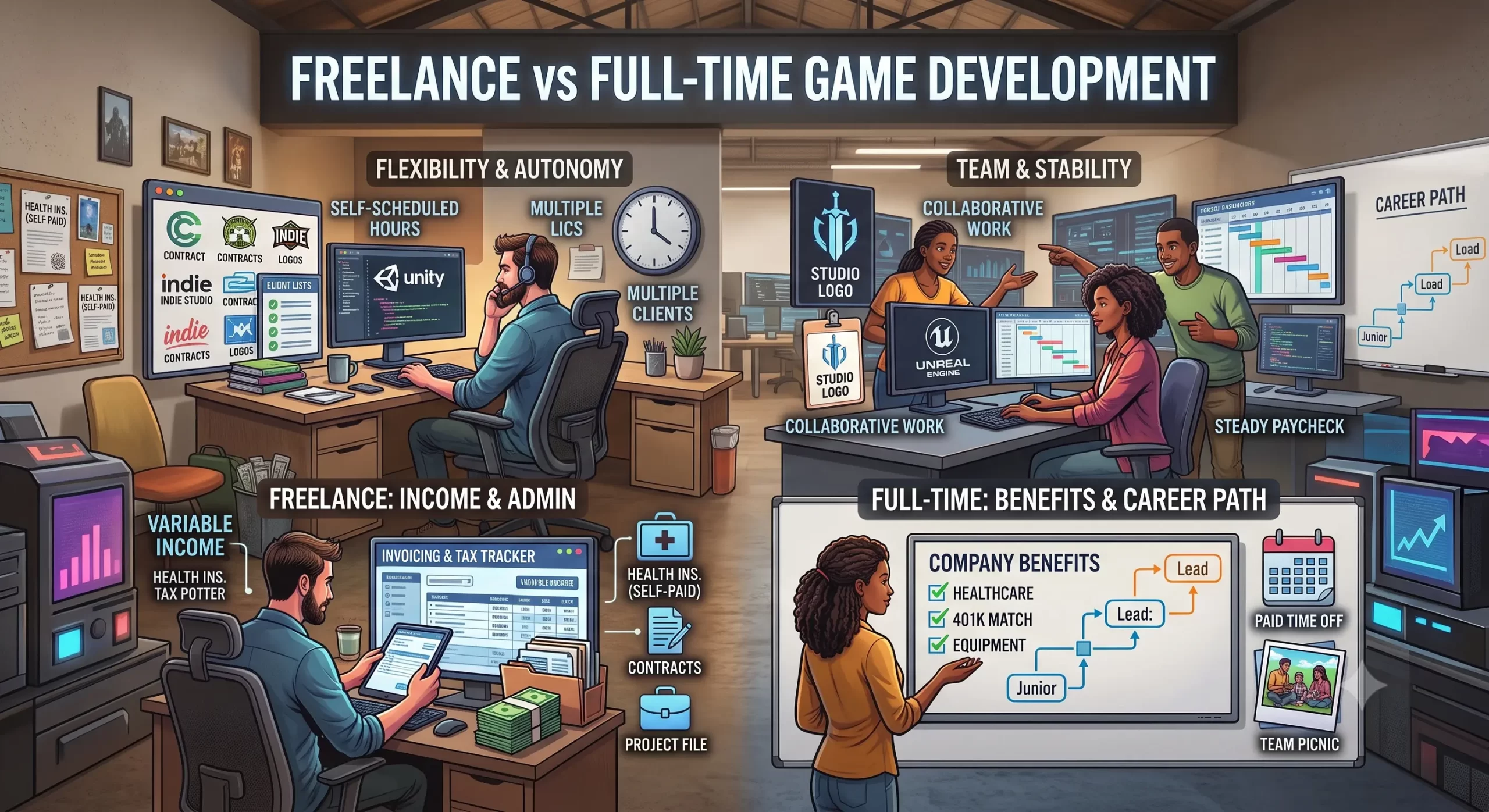

Freelancing vs. full-time: this is a question that comes into nearly every aspiring game developer’s mind. And it’s not an easy one to answer, since both paths come with their own real downsides. Unlike a more traditional career, game development is already hard enough, and I don’t want to sugarcoat that part.
What about the months where no client replies? What about the quiet panic of watching your savings shrink while you wait for work that may never come?
Nobody puts that part in the freelancing pitch. Everyone glorifies it: work on your own terms, choose your own clients, be your own boss, and on paper, it sounds like the obvious choice. But choosing between freelance and full-time is one of the first real tests of how prepared you actually are for this industry.
So let’s talk about it honestly: freelance or full-time, and which one actually serves your game development career in the long run.
Freelancing As a Game Developer
In a full-time career at a game studio, you don’t need to work on everything or serve as the person who knows it all. You specialize in one part of the pipeline- art, design, code, sound- and the studio pays you to do that one thing well. Meanwhile, as a freelance game developer, you must provide more than a single skill because clients look for developers who can take an idea and turn it into a fully fledged game.
A person who specializes in only one skill can’t easily deliver that complete package. Game development rarely works as a one-person job. Look at any freelancing site, and you’ll see that game development freelancers sell a complete package: they will build the entire game.
That doesn’t mean you need to become a jack-of-all-trades, though, if you focus on mastering a game engine instead. Unreal Engine, Unity, and Godot command huge popularity in the market, and creating a game from scratch in any of them gives you a massive advantage. On platforms like Fiverr, clients look for developers who can build either 2D or 3D games without worrying about the fine details. If you can deliver that, the rest becomes much easier.
The real downside of freelancing hits when you can’t land clients. Freelancing is a cutthroat space with fierce competition. If you don’t stand out, you won’t build a successful freelancing career.
Moreover, freelancing offers freedom, but that freedom comes with conditions. You rarely enjoy real peace of mind. You face constant pressure to perform, to deliver a game that matches your promises, and to absorb endless client revisions, especially when clients keep requesting changes without clearly stating what they actually want.
Full-Time Game Development Job
A full-time job at a game studio brings its own set of responsibilities. Unlike freelancing, where you set your own terms and work like a lone wolf handling everything yourself, a studio environment lets you build a game alongside an experienced team where everyone specializes in their own part of the pipeline.
Full-time roles also offer tangible benefits: retirement contributions, health insurance, and other perks that most freelancers simply don’t receive.
However, people often call game development one of the toughest careers for a reason—not just because of the complex technical work, but because studios start you at low pay while demanding high workloads right out of the gate.
Crunch culture reinforces that reality. Reports have highlighted intense crunch hitting Rockstar’s QA team as the release of GTA 6 approaches. These reports remind us that even at the biggest, best-funded studios in the industry, deadline pressure doesn’t vanish just because you hold a full-time job.
So, Freelance or Full-Time?
Honestly, as an emerging game developer, you should join a game studio rather than starting out as a freelancer. At a studio, you will learn alongside people who share your passion for games, and you will build structured, real-world experience instead of trying to prove yourself with an empty portfolio.
Without a strong body of work, clients will rarely hire you as a freelancer. But once you land and complete that first real project, your freelance journey becomes much easier.
Transition to freelancing only when you have gained real experience and established a financial backup plan, because freelancing requires far more than just submitting a resume and acing an interview.
Keep following Game Insider Blog for more such articles.