

A few years ago, if you told a small studio they could generate rough concept art, write placeholder dialogue, and test balance changes without hiring five extra people, they wouldn’t have believed you. That’s roughly where things stand now.
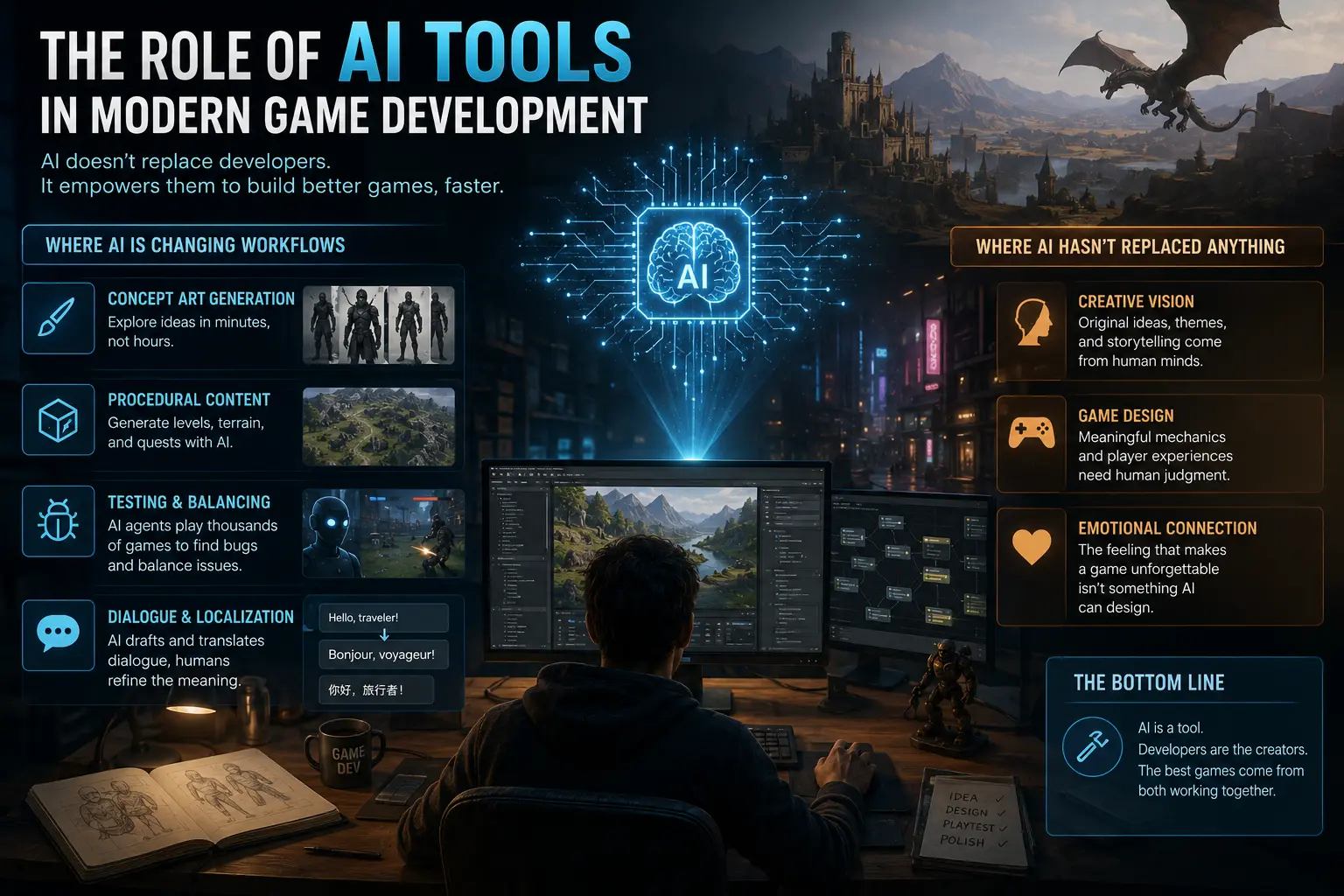
AI tools haven’t replaced game developers. What they’ve done is remove a lot of the repetitive work that used to eat up early production time. A concept artist can generate ten variations of a character silhouette in minutes instead of sketching each one by hand. A writer can draft filler NPC dialogue with AI and then spend their actual time polishing the lines that matter.
None of this is glamorous, but it saves real time, and for small teams working with limited budgets, that time adds up fast.
Where AI is genuinely changing workflows
Procedural generation offers the clearest example. Studios have used procedural systems in games for years, but AI models now allow developers to generate more coherent levels, terrain, and even quest structures without a designer manually placing every element. Testing has also shifted. Studios use AI agents to play through builds thousands of times, catching bugs, exploits, and balance issues faster than a QA team working alone could.
Dialogue and localization provide another clear example. Translating a game into ten languages used to be slow and expensive. AI-assisted translation doesn’t replace human localization experts, but it gives them a faster starting draft to work from instead of a blank page.
Where it hasn’t replaced anything
People still make core creative decisions. AI tools do not handle game design, narrative structure, or the specific feel of a game’s mechanics well on their own. If you ask any AI tool to design a genuinely new game mechanic, it usually produces something derivative that builds on patterns it has seen before. That works fine for filler content, but it fails for the parts of a game that should feel original.
Developers also face a trust problem. Players have pushed back hard against games that use AI-generated art without disclosure, and some studios have walked back their AI use after public backlash. The availability of the technology doesn’t mean studios can use it without damaging their reputation.
What this means for someone getting into the industry
If you’re trying to break into game development right now, knowing how to use these tools is becoming a practical skill, not a shortcut. Studios don’t want someone who lets AI do their job. They want someone who knows exactly which parts of production AI can speed up, and which parts still require a human call. That distinction holds the actual value right now, and it will likely stay that way for a while.
Keep following Game Insider Blog for more such articles.