
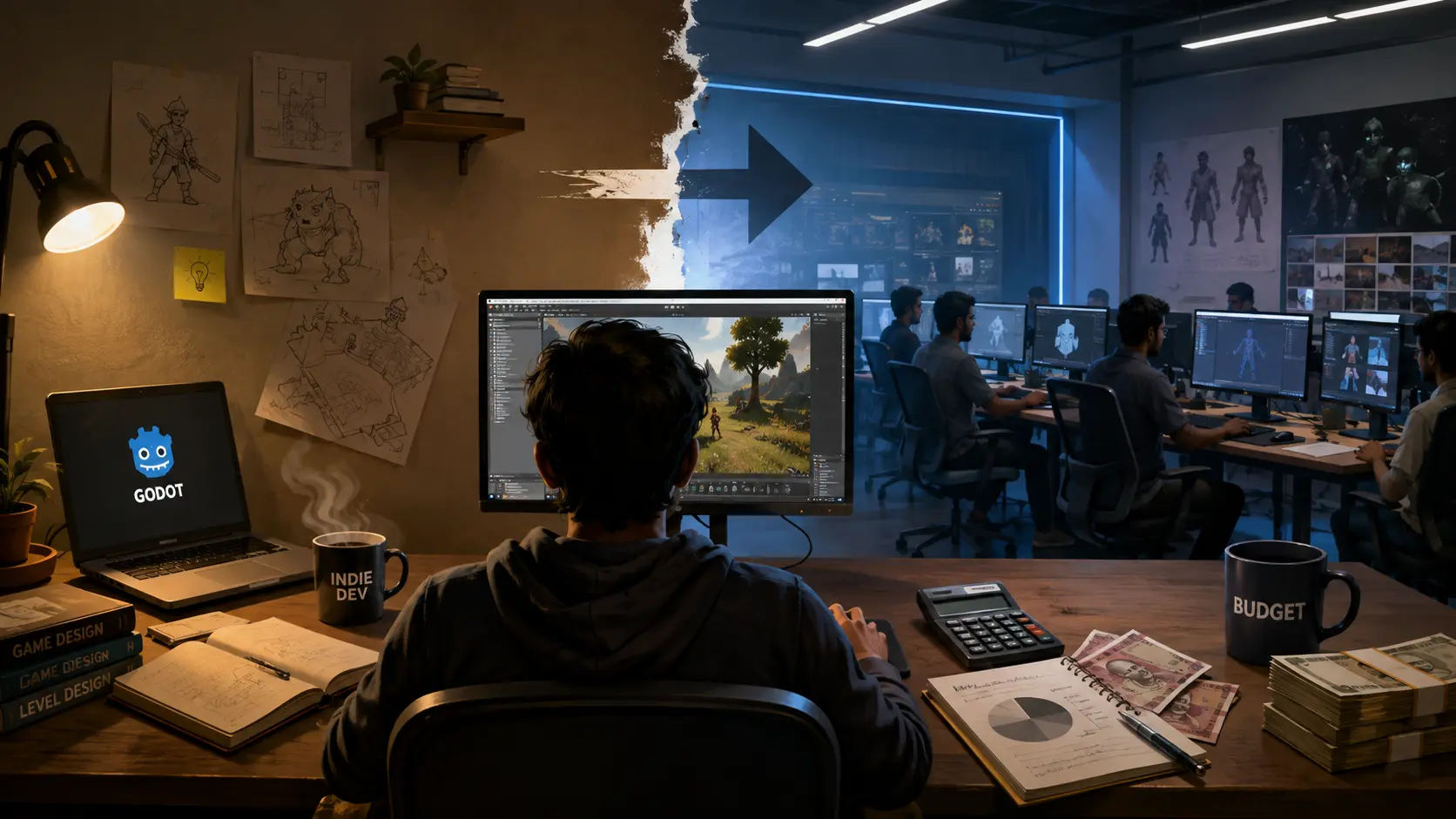

Ask ten Indian developers this question, and you’ll get ten different numbers, and honestly, all of them are correct. Game development in India has genuinely opened up. You don’t need a studio with investors and a Bandra office anymore. A laptop, a free engine, and a lot of stubbornness will get you surprisingly far.
Still, if you’re trying to actually plan a budget, “it depends” isn’t useful. So let’s get specific.
The blunt range: a small solo project can be built for under a lakh. A commercial, feature-complete game with a real team behind it can run into several crores. Where you land depends on three things mostly – scope, platform, and how many people you’re paying.
People are the real cost
Everyone assumes software or engine fees eat the budget. They don’t, not really. It’s salaries. A full game needs programmers, designers, artists, animators, sound people, QA, sometimes a producer to keep everyone from killing each other over deadlines. The moment you’re hiring instead of doing it yourself, your costs jump.
A solo dev working nights and weekends on something scrappy might spend around ₹75,000 total, mostly time, barely any cash. Bring in a second person and stretch it into an actual PC release, and you’re looking at ₹3–5 lakh, depending on how long you take and how polished you want it.
Mobile 2D games sit in a similar lower bracket. But the second you add multiplayer — servers, netcode, live-ops, ongoing patches — costs balloon fast. ₹40 lakh isn’t unusual for that kind of scope, and it’s easy to cross a crore if you’re not careful.
Where the money actually goes
Beyond salaries, you’re paying for:
- Art and animation (2D or 3D)
- Music and sound design
- QA and testing
- Engine/software costs (often lower than people expect)
- Servers and backend, if it’s online
- Marketing — and this one surprises first-timers, because it can rival dev cost
- Store fees and publishing costs
- Support and updates after launch, which never really stops
One thing worth knowing: engines aren’t the bottleneck they used to be. Godot’s free. Unreal doesn’t charge upfront either. Unity has a free tier too, as long as you fall under their thresholds. So the “I can’t afford an engine” excuse doesn’t really hold anymore.
So what should you actually budget?
If this is your first indie game, a few lakh rupees is a realistic ceiling, assuming you’re doing a chunk of the work yourself and keeping the scope tight. Push into a proper PC or console release with some ambition, and ₹10–20 lakh is a fair range.
Anything commercially serious, multiplayer, mobile-with-monetization, AAA-adjacent, and you should expect ₹1 crore or beyond, sometimes well beyond.
But here’s the thing nobody tells first-time devs enough: the budget isn’t really the deciding factor. Scope control is. A tight, well-made small game beats an ambitious one that dies halfway through because the money ran out first. Plenty of Indian devs have learned that the hard way.
Keep following Game Insider Blog for more such articles.