
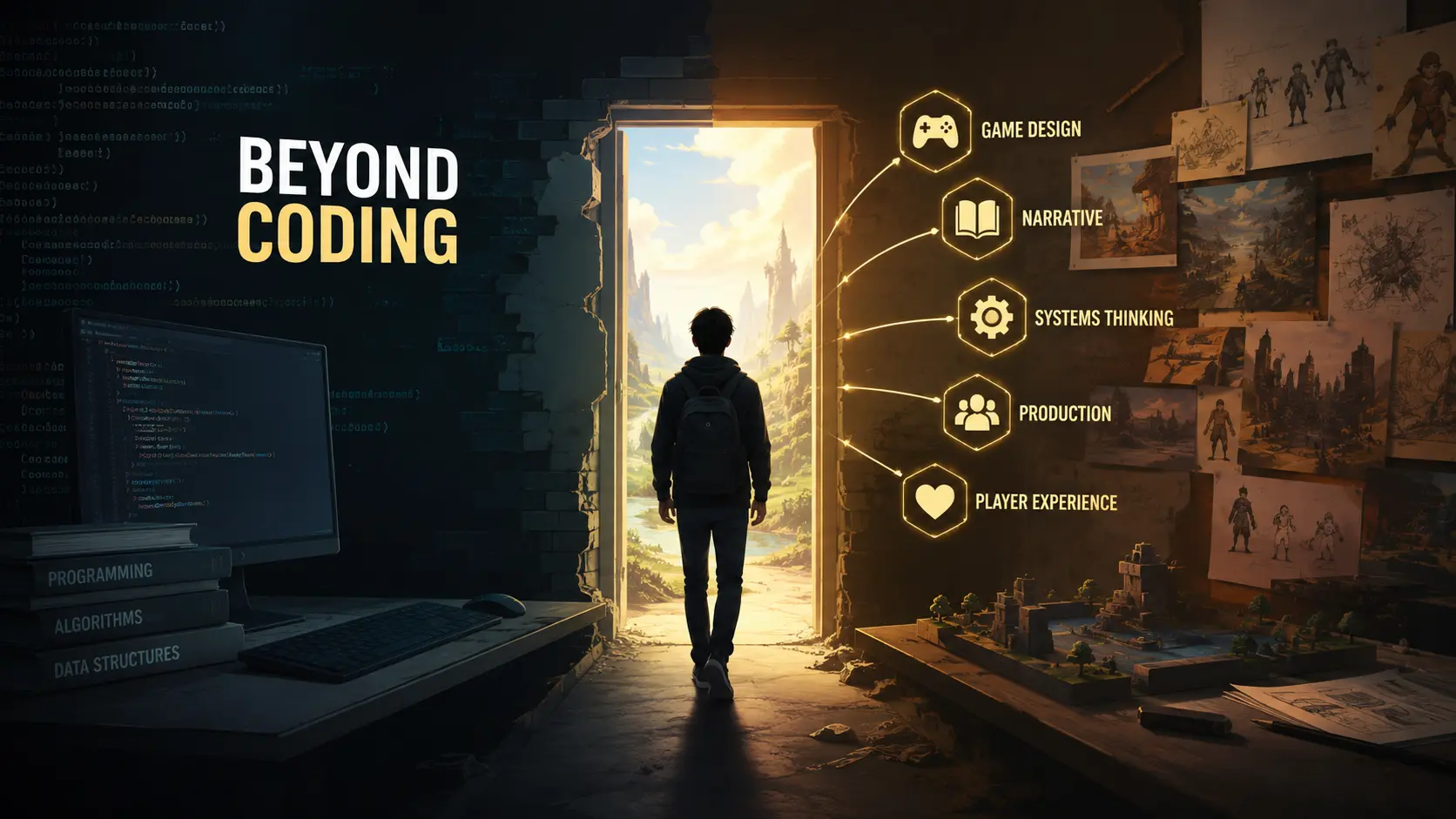

Most game design courses still start the same way: teach the student to code first, worry about everything else later. That approach made sense a decade ago, when the main barrier to making a game was technical. It doesn’t hold up as well now.
Engines like Unity and Unreal have made the technical side far more accessible than it used to be. A lot of what used to require deep programming knowledge can now be done through visual scripting, templates, or asset packs. That’s not a bad thing, but it does mean coding ability alone isn’t the differentiator it once was. Studios aren’t short on people who can write functional code. They’re short on people who understand why a mechanic feels good, why a level pulls a player forward, or why a story beat lands or doesn’t.
What’s missing from most curriculams
Narrative design is one of the clearest gaps. Writing for games isn’t the same as writing a novel or a screenplay; it involves branching structure, player agency, and pacing that has to work regardless of the order a player experiences things in. Very few programs teach this properly, and it shows in how many games have technically sound systems wrapped around a flat story.
Systems thinking is another gap. Balancing an economy, tuning difficulty curves, or designing a progression system that doesn’t feel exploitative or exhausting requires a kind of thinking that’s closer to psychology than programming. Most coding-first curriculums don’t touch this at all.
Then there’s the business and production side. A huge number of game dev graduates have never had to scope a project against a real deadline, manage a budget, or make the kind of cuts a shipping game always requires. They learn to build systems in isolation, without learning how those systems survive contact with a production schedule.
Why this matters more now
As AI tools take over more of the repetitive technical work, the skills that remain valuable are the ones closer to judgment and craft: design sense, narrative structure, systems balance, and the ability to make decisions under real constraints. A curriculum that’s still built around teaching someone to write clean code is preparing them for a version of the industry that’s already shifting.
What education should look like instead?
The programs producing genuinely employable graduates right now tend to treat coding as one tool among several, not the center of the curriculum. They pair technical fundamentals with actual design practice, narrative work, and small shipped projects, where students have to make real tradeoffs instead of working in a vacuum.
Coding got people in the door for a long time. It’s still necessary, just not sufficient anymore. The industry is looking for people who can think about games as systems and experiences, not just as software that needs to run.
Keep following Game Insider Blog for more such articles.